

Learn about our plans for the online exhibition archive
About
For over 50 years, Xchanges has been a cornerstone of Victoria’s art community. From countless exhibitions and performances to art sessions and fundraisers, Xchanges has continually provided programming and outreach to a diverse range of artists and patrons. With decades of contributions comes decades of ephemera—exhibition posters, advertisements, photos and comment pages. This is where I come in, Xchanges’ Web and Public Engagement intern. It’s my task to bring these scattered pieces of information together to create an expanded online archive of historical exhibitions.

Currently, Xchanges’ exhibition archive holds records from 2012 to 2022; however, our online documentation process of exhibitions began in 2003. Although exhibitions have happened here since the late 1960s, it’s unknown if, or where, past volunteers have kept records pre-2003. It would be a marvelous discovery to find these records (perhaps, the next intern’s task?).
The Process
I’ve been working to migrate exhibition records from our old website to our current one. This process has been a long time in the making, requiring a lot of time and careful attention to content, page formatting, and overall record keeping.
For any archive fanatic, like myself, these are the steps that I take to update our online archive: I start by going into our cloud drive and open the folder of the year that I want to upload. I then go in calendar date order and download each file, carefully copying the contents of each web page. I add this information to a new web page, following a standard style convention, and then add in any missing images. In the backend, I make each page search engine optimized, add relevant tags that file it away with similar web pages, and then it’s ready to post. Repeat this process over 120 times and then you have an updated archive!

Why are exhibition archives important?
As an aspiring archivist, this has been a fantastic learning opportunity for me to truly understand the importance of archiving art exhibitions and events in particular.
When we think of archives, most of us think of the tangible objects that museums hold, but what about the digital?
Bigger institutions like provincial museums and private galleries are more likely to have permanent staff, funding, and expertise to maintain databases of this nature. In this context, it makes sense that Xchanges doesn’t have a full archive just yet. Nevertheless, exhibitions are an important part of its history as an artist-run centre, and its artists deserve an accessible way to search its catalogue.
Xchanges holds an important place in local art history and, as Canada’s oldest artist-run centre, it should hold an archive of all the contributing people, objects, and knowledge shared. Having an archive allows us to acknowledge the past work of emerging and established artists and curators and Xchanges’ community-led contributions to the sector. Hopefully, our updated archive will do just that.
Notable local examples of online exhibition archives are UVic Legacy Art Galleries, or the Royal BC Museum. These institutions have different models of what an online exhibition archive can look like. Legacy’s is a website that hosts summaries of exhibitions and sorts them by year and exhibition location dating back to 1974! The RBCM’s website is less expansive, only showing 8 options from the past 4 years and no search engine to find more information. Overall, these examples demonstrate potential modes of organization and presentation for a future Xchanges archive.
Exhibition Fast Facts

Most repeated exhibitions from 2003 to 2012 are the Annual Xchanges Members and the Ground Zero Printmakers show.
From 2003 to 2023 we averaged around 11.47 exhibitions per year; a total of 241 shows!
Our most common exhibitions (in order of popularity) feature paintings, mixed media installations, sculpture and photography.
Over the next few weeks, stay tuned to our Instagram page (@xchangesartists) for a yearly summary of exhibitions!
Favourite Finds
Although I’ve only viewed three exhibitions in-person at Xchanges so far, I feel as if I’ve seen many more after working on this project. It’s been fascinating reading through the descriptions and artist biographies to learn more about their practices. More than ever, it’s made me realize the importance of artist run centres holding space for such unique work. Here are my top intriguing finds:
The Ruffle (2010)

Did you know that Xchanges used to exhibit art on its balcony? From 2009 to 2012, Xchanges hosted roughly 11 shows featuring such as artists John Luna, Debora Alanna, the UVic Visual Arts Students’ Association, and more!
The Ruffle installation was a surprising and daring installation that hasn’t left my mind since I first saw it. A 100 ft long installation along the exterior balcony railings, the Ruffle was created by two anonymous artists.
According to Xchanges artist Christine Clark, the Ruffle “being pretty and delicate and an extreme version of femininity is everything that the space in which it exists is not. In a cement courtyard frequented by male auto-mechanics, the Ruffle becomes strident and immodest, demanding the attention of all (Clark, 2010).”
I enjoyed how the installation interacted with and commented upon its environment and the numerous dichotomies it presented. The Ruffle definitely plays into the absurd and is extremely decadent and playful as an extension of the building.
Child’s Play (2011)
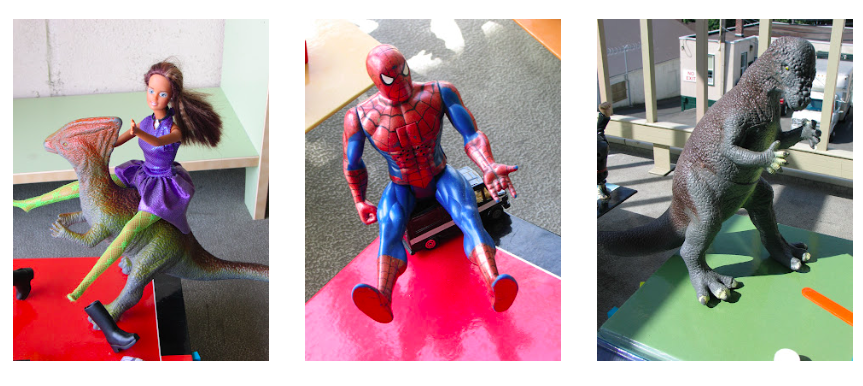
Similarly playful is Robert McTavish’ “Child’s Play,” an interactive Balcony exhibition where visitors follow seven stations with games that enable you to proceed towards the gallery entrance.
I really enjoyed how this exhibition validated the idea of play as a process of learning and exertion, something that we forget as we age and neglect play as an act for children to follow. Interactive exhibits like this are a great way to make us fully participate with the artist’s intentions.
Do you think the Balcony gallery should make a comeback in 2024?
Road Stories (2007)

In Road Stories, Rachel Hellner explores car culture, carelessness, and the disposable nature of our society. In 2005 she began to document roadkill to show the impact cars have on animals that must share their habitat with our ever-expanding road network. She portrays the animals just as she finds them. Ironically, the poses are often serene and peaceful; mostly they appear as sleeping pets or as an animal at play. Showing the animals’ beauty, even in death, is a way Rachel feels “honours” their lives.
Reading through the exhibition page, I wish I was able to see this show in person as it is a thought-provoking and empathy inducing subject. There was an antique slot machine that the art was displayed through, emphasizing the unpredictability of these animals’ deaths and the toll of our environmental interference. A relevant theme then and now!
Project Telephone (2004)

Have you ever played telephone when you were a child? Or better yet, “the exquisite corpse” game?
“Project Telephone” was an exhibition inspired by this interpretive game. Curator Tobla Howell and the eleven participating artists came together to create their interpretations in different media of each other’s work in a relay-like style. Project Telephone also screened films that play on the telephone theme in a variety of ways: California Telephone (directed by Haruko Tanaka) and One Nation Under Tommy (directed by Josh Gibson, et al.).
According to the exhibition description, this project was supposed to be a yearly occurrence. Unfortunately, it did not occur again at Xchanges. I think this is something we need to revisit 20 years later with the same artists. It would be interesting to see the progression in their style of artwork and re-interpretations of the theme.
Updating the archive
Over the next few weeks, we will be launching a yearly segment of past exhibitions to our main archive page. Up on the archive now is the year 2008.
Please stay tuned to our blog posts and social media for upcoming announcements and engaging content to learn more about each year of past Xchanges exhibitions.
Here’s where YOU come in

Archives are only as complete as we make it. We acknowledge that there may be outdated or missing information in our archive. Information is easily lost along the way with many changing hands in a project.
We invite all past artists, curators, volunteers and visitors to contribute to the exhibition archive!
Do you have any images or text (such as artist statements, posters, or artwork credits) to share with us?
Comment on the specific exhibition page to add your brief suggestions or email us at info@xchangesgallery.org to share more information.
We thank you for your continued support for Xchanges exhibitions!
Special thank you to our funders for making this project possible
We gratefully acknowledge the financial support of the Digital Skills for Youth Program coordinated by the Independent Media Arts Alliance (IMAA) and funded by the Department of Innovation, Science and Economic Development Canada.

We also acknowledge the Government of British Columbia and the Capital Regional District in their support for our gallery programming.


Leave a Reply